
Is it possible to manage or reduce product returns by driving consumer behaviour, through behaviour-based pricing and by imposing a penalty for exercising cancellation rights?
Last month ASOS introduced a new tool to calculate each customer’s return rate and to apply fees where ASOS determines that a return rate is too high (calculated over a 12-month period). Under this new framework, customers that have return rates of 70% or more and have placed 3 or more orders will be subject to a return fee (£3.95) unless they keep more than £40 worth of their order https://www.asos.com/payments-and-deliveries/delivery/.
Further, customers that have return rates exceeding 80% and have placed 5 or more orders will be charged a handling fee (£3.95) in addition to the return fee unless they keep more than £40 worth of their order. Customers that have a return rate of less than 70% will have free returns.
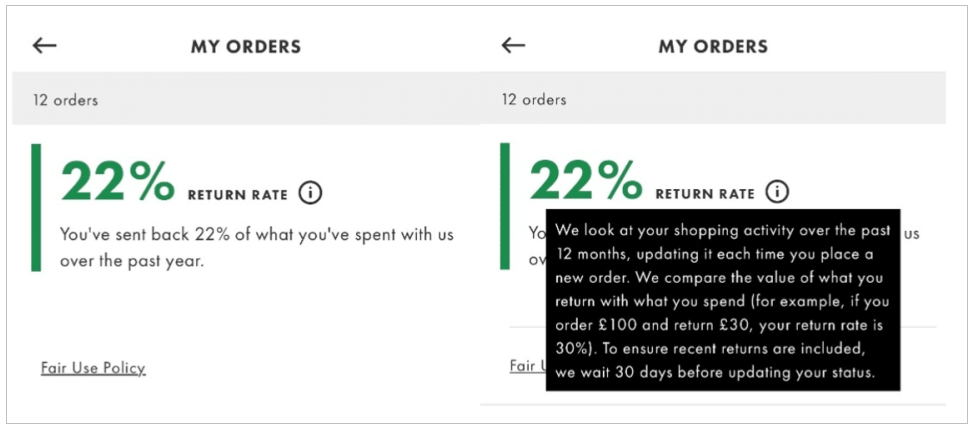
The rationale for this new policy is clear. But does it raise consumer law and data protection concerns?
Does the new returns tool unlawfully penalise consumers for exercising their right to return items?
The relationship between a consumer and a trader is governed by the Consumer Rights Act 2015 (CRA) and the Consumer Contracts (Information, Cancellation and Additional Charges) Regulations 2013 (CCRs).
The CCRs provide that consumers who have entered into contracts via distance communication (for example, online) have the right to cancel a contract with a retailer. Specifically, a consumer can cancel a contract for an online purchase at any time during the cancellation period, but this may be subject to the enhanced delivery costs, deductions for use, costs of the return and the costs of any services provided during the cancellation period.
The general period for cancelling a contract is 14 days (though certain companies may provide longer return periods than this). Upon cancellation, the retailer will need to reimburse any payment received from the consumer, which includes any charges for delivery (but not any enhanced delivery costs).
Looking specifically at the ASOS charges, ASOS are permitted to require consumers to pay for the cost of their returns, provided they have told the consumer before the contract is concluded.
But what of restocking fees? The CCRS provide that, ‘the trader must not impose any fee on the consumer in respect of the reimbursement’. So while return costs are permitted to be deducted from the refund, it would appear that restocking fees are not. The only deductions that are permitted are where the value of the goods has been diminished as a result of handling by the consumer.
In addition the CRA provides that where the consumer is returning faulty goods, the trader must bear the reasonable costs of the return and refrain from imposing any fee on the consumer in relation to the refund (apart from a potential deduction for use). This is recognized by the new ASOS tool as ASOS states that:
‘you can continue to make free returns for products that are faulty or where we have sent you a product that you did not order’
under ASOS’s Fair Use Policy https://www.asos.com/customer-care/returns-refunds/what-is-your-fair-use-policy/.
Interestingly ASOS does mention in the Fair Use Policy that where an item has been returned under this option but is not in fact faulty / incorrect, ASOS can apply return deductions to the refund. So, it appears that ASOS exempts faulty / incorrect items from refund deductions in general, which should mean that no handling fee will be charged (though, this is really not made clear enough by ASOS).
But will returns of faulty/incorrect items affect your return rate percentage?
ASOS does not make this clear in their Returns https://www.asos.com/customer-care/returns-refunds/what-is-your-returns-policy/ or Fair Use Policies or on their Order Issues webpage https://www.asos.com/customer-care/order-issues/somethings-wrong-with-my-item/. Arguably, returns of faulty / incorrect items should NOT affect your return rate percentage as to do so would unfairly penalise consumers for something that is a fault by ASOS. Therefore, if the return of faulty / incorrect items affects a consumer’s return rate percentage, the question will arise as to whether this is an unfair term and so unenforceable or not bind the consumer.
Data protection implications
What is the case is that a customer’s return rate, derived from their transaction history, constitutes personal data under the GDPR. It follows that the use of a return-rate tool to determine whether customers are subject to a return fee involves customer profiling and amounts to a data processing activity, meaning that any retailer deploying such a tool must ensure it complies with applicable data protection requirements.
In particular, the retailer must identify an appropriate lawful basis for processing customer data in this way. The lawful basis is likely either to be that the processing is necessary for the performance of a contract (that is, to administer and enforce the returns policy) or that it is necessary for the retailer’s legitimate interests, such as reducing excessive return behaviour. Where legitimate interests are relied upon, best practice is to carry out and document a legitimate interests assessment to ensure that the business’ interests are not overridden by the rights and freedoms of its customers.
Irrespective of lawful basis, it may also be prudent, depending on the nature, scale and impact of the processing, to carry out a data protection impact assessment to ensure appropriate measures are in place to address privacy risks. Retailers must ensure the accuracy of the data used, particularly where decisions such as charging a fee or, in more extreme cases, suspending or closing an account, are reliant on the data.
Retailers should also assess potential wider uses of return-rate data and their lawfulness, including whether the data could be repurposed for marketing, whether it might be shared with third parties, and whether attempts to aggregate and anonymise the data for these purposes have in fact been achieved.
Transparency is always important. Introducing new uses of customer data, and the applicable lawful grounds, should be clearly explained in updated privacy notices, including how the data is used and the consequences for customers.
A particular GDPR provision – Article 22 – may also apply. It restricts decisions based solely on automated processing that have legal or similarly significant effects. Businesses will need to determine if such decision-making falls within the scope of Article 22, meaning additional safeguards such as meaningful human intervention and the ability for customers to challenge decisions are required.