


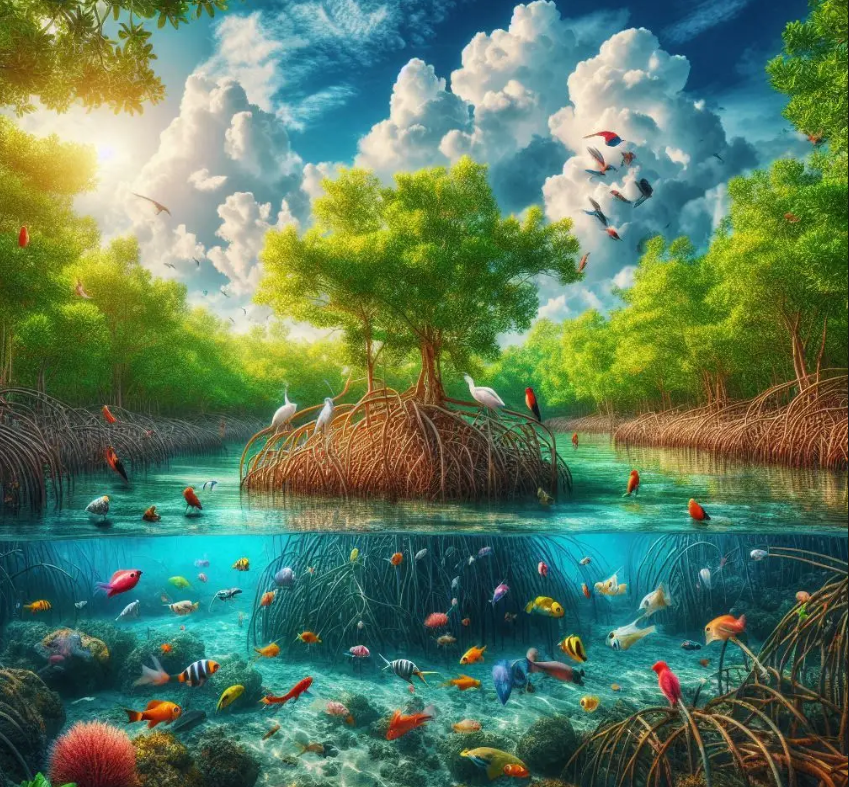
Every month, Kolleqtive gives a percentage from every product sold to support mangrove restoration. It’s a choice that feels deeply aligned with what we care about: human wellbeing, environmental health, and the sense of safety we all crave in a world that’s constantly shifting.
Because the truth is, our inner world and our outer world are inseparable.
When the planet feels unstable, we feel unstable.
When ecosystems thrive, we feel more grounded, more connected, more confidence, and more hopeful.
And few ecosystems embody that connection as powerfully as mangrove forests.

Why Mangroves Matter (Far More Than Most People Realize)
Most people know by now that mangroves are climate heroes.
But the scale of their impact still feels unbelievable—they store as much carbon as the US and China emit combined each year. That’s huge. But what makes them so extraordinary isn’t just the amount of carbon they hold—it’s how they do it.
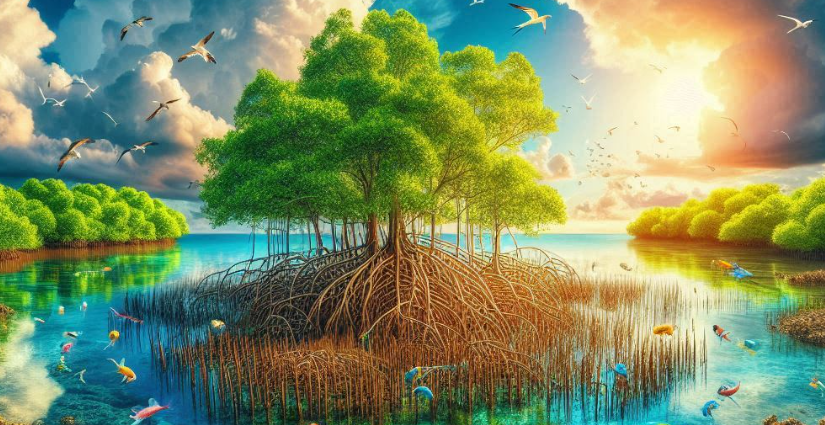
Mangroves live where almost no other tree can survive: right on the edge of land and sea.
Salt water should kill most plants, but mangroves have evolved incredible ways of dealing with it. Their root systems act like filters, letting water in while blocking around 90–95% of the salt. Whatever little salt does sneak through gets pushed back out through tiny glands on their leaves. Yes—if you licked a mangrove leaf, it would actually taste salty.
And then there’s their breathing.
Because their roots grow in waterlogged soil, they would “drown” without a workaround. So, they send up aerial roots—pneumatophores—thin little structures that stick out of the water like snorkels. These allow them to breathe where other trees simply can’t. This lets mangroves take root in the in-between places: tidal zones, muddy shorelines, the liminal space where land meets sea.
That’s where their climate superpower begins.
How Mangroves Lock Away Carbon for Centuries
Mangroves don’t just store carbon in their trunks—they create a whole system that traps carbon again and again.
Their tangled roots slow down incoming and outgoing tides, causing carbon-filled material to settle: silt, shells, dead plankton, fish bones. All of this organic matter sinks into the soil and gets buried under the mangroves’ own fallen leaves, which are also rich in carbon.
Then the cycle repeats:
- Tree traps waterborne carbon
- Waterborne carbon traps tree carbon
- Tree carbon traps more waterborne carbon
Layer after layer builds up, and because the soil is waterlogged and low in oxygen, that carbon stays locked away for centuries. Even thousands of years.
As long as the mangroves stand, their carbon stays safely stored—and they keep capturing more.
The Problem: We’re Losing Mangroves Fast
This is where the story turns.
Across the world, mangrove forests are being cleared for shrimp farms, illegal logging, tourist developments, and other destructive activities. And when mangroves are destroyed, it’s not just the trees we lose. All the carbon they buried for hundreds of years suddenly gets exposed.
Once released, it heads straight back into the atmosphere—adding to the CO₂ from cars, livestock, and industry that’s overheating our planet.
Protecting mangroves isn’t just a nice environmental gesture.
It’s one of the most powerful actions we have in the fight against climate change.
Why This Matters to You, Me, and Kolleqtive
Our wellbeing is tied to the wellbeing of the world we live in.
When we talk about feeling grounded, feeling safe, feeling connected—nature plays a massive role in that. We breathe better when ecosystems are healthy. We relax more when we feel the planet is cared for. We feel hope when regeneration is happening.
Mangroves are literal protectors—of coastlines, of biodiversity, of communities, of climate.
And supporting them is our way of contributing to that sense of safety on both a global and personal level.
So every month, with every product purchased, a portion goes toward restoring these extraordinary trees. It’s a small action that adds up—one that aligns with our mission to nurture both human and environmental health.
Because when nature thrives, we thrive.